
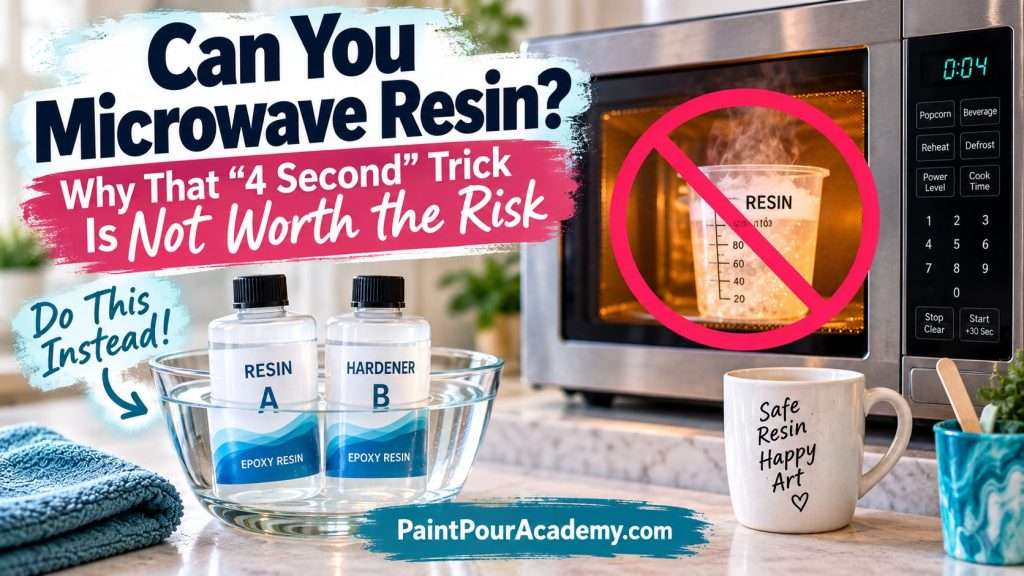
Can you microwave resin to thin it out before pouring? I was scrolling through a resin Facebook group the other night, coffee in hand, minding my own business, when I saw a comment that stopped me cold. Someone had been told that if you microwave resin for “4 seconds” before pouring, it thins right out and makes your pour easier.
Twenty-six comments in, half the group was arguing about it. Some people swore they’d done it and were fine. Others were horrified. One comment mentioned a reptile warmer. Another person posted a photo of hazmat suits as a joke, which, honestly, is not far off from the truth.
So I did what I always tell my students to do when something in a Facebook group doesn’t sit right: I went straight to the source. I reached out to two resin manufacturers directly and asked them the question everyone in that comment section was arguing about. Can you microwave resin to thin it out, and if not, why not? Here’s exactly what they told me.
Can You Microwave Resin? Why Experts Say No
Both manufacturers gave me the same answer, independently of each other, and it was a firm no.
Bessie, from the Let’s Resin support team, walked me through it step by step. Microwaves don’t heat resin evenly. Different parts of the same batch can hit different temperatures at the same time, which makes the whole thing unpredictable. That uneven heating can trigger something called thermal runaway, where parts of the resin overheat so fast that it starts an uncontrolled reaction. In her words, this can cause the resin to bubble, smoke, or even burst out of its container.
Paul, from TotalBoat, backed that up from a slightly different angle. He explained that the uneven heating can set off an uncontrolled exothermic reaction, which is the technical term for a chemical reaction that generates its own heat and keeps feeding itself. That reaction can release toxic vapors and create a real risk of burns or fire. He also pointed out something a lot of us don’t think about: microwaving can actually change the chemical makeup of the epoxy itself, which messes with how it cures and how strong the final piece ends up being.
Both of them also raised the same food safety point, and this one is easy to miss. If you microwave resin, that microwave should never touch food again. Resin can leave behind chemical residue and fumes that stick around in a way you can’t just wipe off with a paper towel.
If you’d like to check out the brands behind these responses, you can find Let’s Resin here and TotalBoat here.
What to Do Instead
The good news is there’s a simple, safe way to get the exact result people are chasing when they reach for the microwave. Both Bessie and Paul recommended the same thing: a warm water bath.
Here’s how it works. Keep your resin bottles sealed, and set them in a container of warm (not boiling) water for about 10 to 15 minutes. This warms the resin gently and evenly, which lowers its viscosity and helps it pour more smoothly, without any of the risk that comes with a microwave. It’s the same reason I always tell my students to store their resin somewhere warm the night before a project if their studio runs a little cold. Resin behaves so much better when it’s not fighting the temperature of the room.
Why This Myth Keeps Coming Back
I get why this trick is tempting. Resin can be stubborn in a cold garage or a chilly studio, and a microwave feels like a fast fix. But “fast” and “safe” aren’t always the same thing, and resin is one of those materials where a shortcut can genuinely go wrong in a way that isn’t fixable.
This is exactly the kind of thing I want my students to feel comfortable asking about instead of guessing. If you’ve ever seen a tip like this floating around and wondered if it was actually true, that instinct to double check is a good one. Keep it.
If you want a solid foundation so you’re not relying on Facebook comment sections for advice like this in the first place, my Beginner’s Guide to Resin Art course covers the basics start to finish, and my post on my top 10 resin tips for beginners rounds up the other mistakes I see most often.
A Quick FAQ
Is resin dangerous if you microwave it? Yes, it can be. Manufacturers point to uneven heating, the risk of an uncontrolled reaction, and possible fumes as real safety concerns, not just theoretical ones.
What’s the best way to warm up resin before pouring? A warm water bath. Place your sealed bottles in warm water for 10 to 15 minutes before mixing. It’s gentle, even, and doesn’t put your health or your kitchen appliances at risk.
Can microwaving resin affect how it cures? According to TotalBoat, yes. Uneven heating can alter the chemical composition of the epoxy, which can affect both curing and the final strength of your piece.
Ready to Build Your Resin Skills the Safe Way?

If you’re new to resin, or you’ve tried it and keep running into bubbles, softness, or other frustrating surprises, the Resin Success Bundle is built to fix that. It’s 3 complete courses plus 3 bonus reference guides, including a Resin Troubleshooting Cheat Sheet, so you’re working from real knowledge instead of Facebook comment sections.


What a great and informative article. Thank you for spreading the word of good reason rather than quick tip of the day. You sound like a great teacher and your students are so lucky to have you
Anita, thank you so much for this — it truly made my day! Comments like yours are exactly why I love sharing this with a wider audience instead of just tossing out quick tricks. I want people to actually understand the “why” behind what they’re doing, not just follow steps blindly.
I’m so glad it came through that way, and I really appreciate you taking the time to write this. 💛